 by
by Buying a new construction home in Florida is exciting, but it requires specialized expertise from your real estate agent. Whether you’re purchasing in Orlando, Tampa, Jacksonville, Miami, Davenport, Winter Haven, or any other Florida city, new builds involve builder contracts, construction timelines, and unique negotiation points that many real estate agents aren’t equipped to handle. Here are the telltale signs your realtor dropped the ball during your new construction purchase.
🚫 They Encouraged You to Go It Alone
One of the biggest red flags is a real estate agent who suggested homebuyers didn’t need their representation during the actual process but still insisted on being listed on the contract to receive compensation. This is a serious ethical issue common in fast-growing markets like Cape Coral, Port St. Lucie, Lakeland, Davenport, Minneola, and Groveland – if they’re collecting a commission, they should be actively working for you throughout the entire transaction.
A realtor who tells property buyers to “just go to the sales office yourself” or “you don’t really need me there” but then shows up only to sign paperwork and collect their fee is not providing the representation you deserve. The builder has already allocated funds for buyer agent compensation, so walking in without active representation doesn’t save you money. it just means you’re not getting the advocacy and expertise that compensation is meant to provide.
A good real estate agent knows their presence protects the homebuyer’s interests from the very first visit. They should accompany you to the sales office, attend design center appointments, be present for inspections, and actively guide you through every step. Whether you’re buying in Sarasota, Fort Myers, Ocala, The Villages, Zephyrhills, Land O Lakes, or Parrish, if your agent wasn’t there doing the actual work but still got paid as if they were, that’s a major red flag.
⚖️ They Didn’t Advise You to Consult an Attorney
In Florida, real estate agents are not attorneys and cannot provide legal advice. Whether you’re purchasing in Tallahassee, Pensacola, Fort Lauderdale, Lake Wales, Lake Hamilton, or Palmetto, if your realtor didn’t recommend that a home purchaser have a real estate attorney review the builder’s contract, that’s a major red flag. Builder contracts are complex legal documents, often 30-50 pages with terms heavily favoring the developer. Your real estate agent should have recognized their limitations and directed first-time homebuyers to legal counsel for contract review, especially regarding contingencies, completion deadlines, warranties, and arbitration clauses.
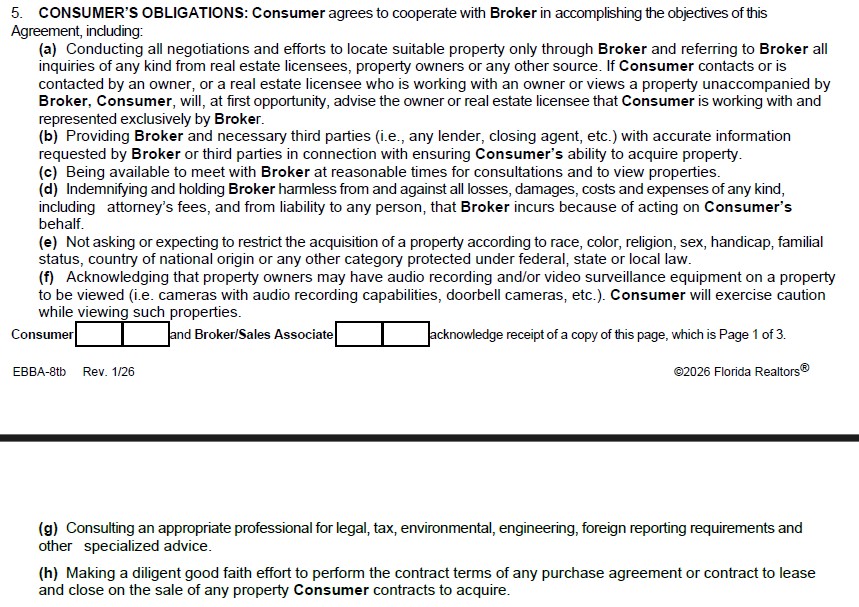
Florida Realtors Buyer Brokerage Agreement Note Section 5 Line (g) Consulting an appropriate professional for legal, tax, environmental, engineering, foreign reporting requirements and other specialized advice.
🔍 They Had No Knowledge of the Builder’s Reputation
A competent realtor researches the builder before property buyers sign anything. In booming markets like Naples, Bonita Springs, St. Petersburg, Clearwater, West Palm Beach, Winter Haven, Lake Alfred, and Davenport, numerous builders are active, and their reputations vary significantly. They should know the company’s track record for quality, whether they typically finish on time, how they handle warranty claims, and if there are common complaints from previous buyers. Most importantly a mention of how every house is built by different local contractors and all homes have defects if left unchecked. If your real estate agent couldn’t tell new home buyers anything about the builder beyond what’s in their marketing materials, that’s a problem.
📋 They Lacked Understanding of Florida Building Codes and Manufacturer Installation Requirements
This is a critical knowledge gap that leaves residential buyers completely vulnerable, especially in Florida where hurricane codes, wind ratings, and flood requirements are stringent. Whether you’re building in Panama City Beach, Daytona Beach, Melbourne, Palm Coast, Minneola, Groveland, Zephyrhills, or Land O Lakes, if your real estate agent doesn’t understand Florida building codes or manufacturer installation instructions for various home components, they have absolutely no ability to assess whether the home is being built properly or if a completed house is well-constructed.
They Can’t Monitor Construction Progress: During site visits in communities across Gainesville, Kissimmee, Winter Haven, Bradenton, Lake Wales, Lake Hamilton, Parrish, or Palmetto, a knowledgeable realtor should be able to spot obvious issues, improper flashing around windows, inadequate siding installation, improper roof installation, and more contrary to manufacturer specifications. If your real estate agent just walked through saying “looks good” without actually knowing what to look for, they provided no value to the house buyer during those visits.
They Can’t Evaluate the Finished Product: At the final walkthrough, does your realtor know if the proper repairs have been made?
They Can’t Assess the Inspector’s Report: Here’s a critical problem many buyers in Punta Gorda, Port Charlotte, Vero Beach, Stuart, Lake Alfred, Davenport, and Haines City don’t consider – if your real estate agent doesn’t understand building codes and proper installation practices, how can they tell if the home inspector did a thorough job? A comprehensive inspection report for new construction in Florida should be detailed and extensive, documenting everything from foundation to roof, with special attention to hurricane-resistant features.
If your realtor received a thin inspection report with vague observations and didn’t question whether the inspector actually did their job, that’s because they lack the knowledge to evaluate the quality of the inspection itself. They can’t distinguish between a thorough, competent inspector who found minimal issues and a lazy inspector who barely looked. This means prospective buyers could have a false sense of security based on an inadequate inspection that your real estate agent had no ability to assess.
Warning Signs Your Real Estate Agent Lacks Technical Knowledge:
- They never pointed out any concerns during construction site visits
- They couldn’t explain what was happening at each construction phase
- They accepted the inspection report without questions, regardless of how brief it was
- They couldn’t answer technical questions about Florida-specific requirements for beginner homebuyers
- They seemed confused when you brought up specific code requirements or installation standards
- They dismissed concerns about workmanship because “it looks fine to me”
New construction oversight in Florida requires either technical knowledge or the wisdom to bring in experts who have it. A realtor serving clients in Delray Beach, Boca Raton, Key West, Fort Pierce, Lake Wales, Minneola, Zephyrhills, or anywhere else in the state who lacks both the knowledge and the humility to acknowledge their limitations cannot effectively protect homebuyer interests in a new construction purchase.
🏛️ They Claimed County or Builder 3rd Party Inspections Were Sufficient
This is a dangerously misleading statement that reveals either ignorance or negligence. Whether you’re building in Hillsborough County, Pinellas County, Orange County, Lee County, Polk County (covering Winter Haven, Lake Alfred, Lake Wales, Lake Hamilton, and Haines City), Pasco County (including Zephyrhills and Land O Lakes), or Manatee County (including Parrish and Palmetto), if your real estate agent told residential buyers that they didn’t need independent inspections because “the county inspectors take care of it,” they fundamentally misunderstood what municipal inspections cover – or worse, they know the truth and misled you anyway.
County or city building inspectors check for code compliance – ensuring the construction meets minimum safety and building standards required by law. However, the reality is often far less reassuring across Florida municipalities: many county inspectors are overworked, underpaid, and covering multiple job sites per day. It’s not uncommon for inspectors to simply sign off on paperwork and leave without conducting a thorough examination. They’re checking boxes on a form, not protecting the investment property buyer or home purchaser.
Even when county inspectors do their job properly, they’re only looking at structural safety and code violations, not quality of workmanship, proper installation techniques, potential defects, or whether you’re getting what you paid for. They won’t catch improperly installed tile, an undersized HVAC system, poor insulation, plumbing that meets code but will likely leak, or the hundreds of cosmetic and functional issues that could become expensive problems down the road.
An independent inspector works exclusively for the house buyer, not the municipality or builder. They conduct thorough pre-drywall inspections when problems can still be easily and inexpensively fixed, and comprehensive final inspections before you close. A realtor who discouraged independent inspections either didn’t understand the critical difference or prioritized a quick, smooth transaction over the long-term interests and financial protection of first-time homebuyers.
⏱️ They Discouraged a Thorough Inspection or Interfered with the Inspector
This is one of the most alarming red flags and potentially crosses into unethical territory. If your real estate agent told new home buyers not to get a “detailed” inspection or suggested you should only get a “quick walk-through” instead of a comprehensive inspection, they were actively working against your interests. This problem occurs in new construction communities throughout Doral, Coral Springs, Pembroke Pines, Palm Bay, Davenport, Minneola, Groveland, and Parrish.
Even worse is when a realtor directly instructs the inspector to rush through the job. Telling an inspector “don’t spend too much time” or “just do a quick once-over” is a betrayal of the real estate buyer’s trust and interests. A thorough new construction inspection in Florida should take several hours .the inspector needs time to check every system, climb into the attic, inspect the crawl space, test appliances, check for proper grading, examine the roof and hurricane tie-downs, and document their findings properly.
Why would a real estate agent do this? Usually it’s because they want to avoid potential deal complications, don’t want to upset the builder, or simply want to close quickly and move on to the next transaction. Some realtors have ongoing relationships with builders in popular areas like Spring Hill, Riverview, Wesley Chapel, Clermont, Winter Haven, Zephyrhills, Land O Lakes, and Lake Wales, and don’t want to be seen as “difficult” by bringing in inspectors who might find problems.
Your realtor should be encouraging the most thorough inspection possible for every property buyer. They should want problems discovered before you own them. If your agent discouraged comprehensive inspections or tried to rush the inspector, they prioritized the transaction closing over the financial protection of first-time property buyers. This behavior may also violate their fiduciary duty to you as their client.
⚠️ They Told You to Wait Until After Closing to Inspect Because “The Warranty Will Cover It”
This is perhaps the most financially devastating advice a real estate agent can give, yet it’s shockingly common in high-volume markets like Homestead, Apopka, Plant City, Haines City, Lake Alfred, Lake Hamilton, and Palmetto. If your realtor suggested starter home buyers skip the pre-closing inspection and instead rely on the builder’s warranty to fix problems after you move in, they either don’t understand how builder warranties actually work or they prioritized closing the deal over protecting you.
Here’s the harsh reality, builder warranties are not the safety net your real estate agent made them out to be. While builders are required to provide warranties under Florida law, getting them to honor those warranties can be an uphill battle for any home purchaser. Many builders will dispute what’s covered, claim issues are due to homeowner negligence rather than construction defects, delay repairs indefinitely, or simply refuse to fix problems they deem “cosmetic” or “within acceptable tolerances.”
Once you’ve closed on the property, the homebuyer’s leverage is gone. The builder has your money, the sale is complete, and you now own any and all problems with the house. Many buyers in Miramar, Boynton Beach, Wellington, Jupiter, Davenport, Winter Haven, Minneola, and Groveland discover that getting warranty repairs often requires sending demand letters, filing complaints with state licensing boards, or even hiring attorneys and filing lawsuits a process that can – thousands of dollars and take months or years to resolve.
Before closing, residential buyers have maximum leverage. If the inspection reveals problems, you can demand they be fixed before you complete the purchase, request credits, or even walk away from the deal. After closing, you’re at the builder’s mercy and facing the very real possibility of paying out of pocket to fix defects that should have been caught and corrected before you took ownership.
A competent realtor knows this and insists on thorough pre-closing inspections at multiple stages, especially the critical pre-drywall and final walkthrough inspections. Any real estate agent who tells entry-level buyers to “just close and let the warranty handle it” is either dangerously uninformed or prioritizing their commission over your financial wellbeing.
🤝 They Were Secretly Collaborating with the Builder’s Sales Agent Against You
This is one of the most serious breaches of fiduciary duty, and unfortunately, it happens more often than real estate buyers realize across Florida’s booming construction markets in Leesburg, Haines City, Winter Garden, Sanford, Lake Wales, Lake Hamilton, Zephyrhills, Land O Lakes, Parrish, and Minneola. If you noticed your realtor seemed unusually chummy with the builder’s sales representative, had private conversations that excluded you, or appeared to be working together to push you toward a purchase decision, the prospective buyer’s suspicions may have been correct.
Some real estate agents develop cozy relationships with builder sales teams because they want repeat business and easy commissions. New construction deals can be lucrative and relatively simple compared to traditional sales, so unethical agents may prioritize maintaining good relationships with builders over representing the homebuyer’s best interests. Warning signs include:
Private conversations: Your realtor and the builder’s rep step aside to talk without the house buyer present, then return with unified messaging about why you should move forward, why certain requests aren’t reasonable, or why you should accept certain terms.
Pressure tactics in tandem: Both your real estate agent and the builder’s rep use similar language and tactics to create urgency – “this lot won’t last,” “prices are going up next week,” “another buyer is interested,” or “you need to decide today.”
Your concerns are dismissed by both: When the home purchaser raises legitimate issues about the contract, pricing, quality concerns, or wants to negotiate, both parties minimize your concerns with the same talking points.
Your realtor defends the builder excessively: Instead of advocating for the property buyer, your real estate agent consistently takes the builder’s side, explains away problems, or discourages you from making reasonable requests.
Reluctance to negotiate: Your realtor seems uncomfortable or unwilling to push back on the builder’s terms, prices, or demands, treating everything as non-negotiable when it often isn’t.
They discourage your own research: Your real estate agent doesn’t want first-time homebuyers talking to other buyers, researching the builder’s reputation, or taking time to think things over.
This collusion fundamentally violates the realtor’s duty to represent the real estate buyer’s interests. You’re their client, not the builder. If your real estate agent was essentially functioning as a second sales agent for the builder rather than your advocate, they betrayed their professional responsibility and potentially – you thousands of dollars in unnecessary expenses, unfavorable terms, or a home with undiscovered defects.
📅 They Didn’t Attend Critical Appointments
Your realtor should be present for the Foundation, pre-drywall walkthrough, final walkthrough at the closing. Whether you’re building in Deltona, Titusville, Ormond Beach, Palm Harbor, Davenport, Lake Alfred, Groveland, or Palmetto, these inspections are crucial opportunities to identify issues before they’re covered up or become the homebuyer’s responsibility. A real estate agent who was “too busy” to attend these appointments or sent an unlicensed assistant in their place demonstrated poor prioritization of the residential buyer’s interests.
💰 They Failed to Negotiate on Your Behalf
Many buyers assume new construction prices are non-negotiable, but that’s rarely true, especially in competitive markets like Pompano Beach, Largo, Davie, Port Orange, Winter Haven, Winter Garden, Lake Wales, Minneola, and Haines City. A skilled realtor advocates for upgrades, closing – assistance, rate buy-downs, lot premium reductions, or other concessions on behalf of new home buyers, especially during slower markets. If your real estate agent accepted the builder’s first offer without attempting to negotiate for the first-time property buyer, you likely left money on the table.
📞 They Were Uninvolved During Construction
Months can pass during the building process, and communication matters. A good realtor checks in regularly, monitors construction progress, alerts the house buyer to potential delays, and maintains contact with the builder’s representative. If the property buyer only heard from your real estate agent at contract signing and closing, they weren’t earning their commission. This is especially problematic in rapidly developing areas like North Port, Middleburg, Palm Beach Gardens, Fleming Island, Davenport, Zephyrhills, Land O Lakes, Lake Hamilton, and Parrish where beginner homebuyers need consistent guidance.
🎨 They Pressured Quick Decisions on Upgrades
Design center appointments can be overwhelming for first-time homebuyers, with hundreds of choices and price tags that add up quickly. A real estate agent working in the residential buyer’s best interest helps you prioritize upgrades that may add resale value. If yours rushed the property buyer through decisions or didn’t point out that certain “upgrades” might be standard features elsewhere, they weren’t protecting your investment. This frequently occurs in luxury markets like Sarasota, Naples, and Boca Raton, as well as volume markets throughout Central Florida including Winter Haven, Davenport, Lake Wales, Haines City, and surrounding Polk County communities where entry-level buyers are making their first purchase.
✅ Moving Forward
If you’re currently working with a real estate agent on a new construction purchase anywhere in Florida – from Pensacola to Miami, from Jacksonville to Fort Myers, or in Central Florida communities like Winter Haven, Davenport, Lake Wales, Lake Alfred, Lake Hamilton, Haines City, Minneola, Groveland, Zephyrhills, Land O Lakes, Parrish, and Palmetto – and recognizing these red flags as a homebuyer, first-time property buyer, or real estate purchaser, know that you have options. You can request a different agent within the same brokerage, or in some cases, terminate your buyer agreement. For future purchases, residential buyers should seek out realtors who specifically advertise new construction expertise in Florida and ask pointed questions about their experience during your initial consultation.
The right real estate agent brings invaluable expertise to new construction purchases, protecting the house buyer’s interests throughout a complex, months-long process – while knowing when to recommend professional legal counsel for matters beyond their scope. Don’t settle for less than the representation you deserve when buying new construction in Florida as a home purchaser, whether you’re a first-time homebuyer, beginner homebuyer, starter home buyer, move-up buyer, or relocating home buyer. 🏡✨
- About the Author
- Latest Posts
I’m Rich Noto, a Florida Real Estate Agent & Home Inspector with a focus on the best price house, and quality new construction oversight. I specialize in new house purchases which includes getting homes built to Florida Residential Building Codes and Manufactures Installation Instructions.
I help homebuyers beyond the “standard Real Estate sales agent” (who may disappear after purchase contract) by dealing with sales, construction managers, attending/monitoring inspections, and spotting defects. This helps buyers catch problems early.
Builders pay my commission. Does not apply after buyer is in contract(all builders) or has contacted the builder alone(some builders). This top rated service is available at any town throughout Florida.
Any agent can “sell new homes” or be a “high volume seller” or have “builder relationships”. Sales marketing has nothing to do with understanding constructions defects. Home Defects are the main expense a homeowner will have and can cost home owners thousands of $$$. Depreciating future resale value.
I enjoy teaching my customers how new homes are built. How to identify water intrusion. And the steps to keep a house well maintained to prevent leaks over time. Out of state buyers get special walkthrough and inspection videos.
Whether its a completed move-in ready inventory house, or a to be built custom on the land, or a spec house. You deserve the best quality for your money.
You must be logged in to post a comment.